Our short answer: flat pedals are the simplest and safest to get off, clipless pedals give racers the most rigid connection, and magnetic pedals sit in between – your foot stays connected, but comes free in any direction when you need it to. For most beginners, commuters and trail riders who want more control without the fear of being stuck, magnetic pedals are the best compromise.
For a long time, riders had to pick between two extremes: flat pedals, where the foot can bounce off on rough ground, or clipless pedals, which take weeks to learn and often lead to a slow-motion fall at a junction. Magnetic pedals add a third option. Below we compare all three.
The three pedal types at a glance
1. Flat pedals
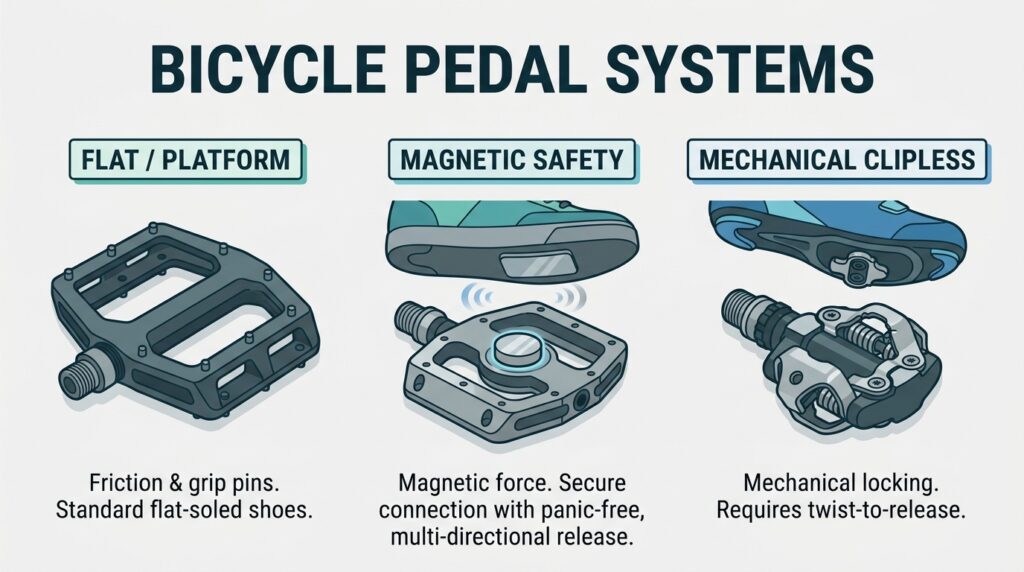
A wide platform with metal pins or a grippy surface. The shoe is held only by friction.
- Good for: relaxed riding, dirt jumps, skills practice and anyone who wants to get on and off instantly in normal shoes.
- Downside: on rough ground your feet can bounce off, and you can only push down – not pull up.
2. Clipless pedals
The name is confusing: “clipless” means “without toe clips”. In fact a spring-loaded mechanism locks a cleat under your shoe to the pedal (e.g. Shimano SPD, SPD-SL, Look Keo).
- Good for: racers on road and cross-country who want a rigid, fixed connection.
- Downside: you only get out by twisting your heel outwards. In a sudden stop that movement often doesn’t happen in time, and you fall. The limited rotation of the cleat can also strain the knees.
3. Magnetic pedals
Strong neodymium magnets in the pedal hold a thin steel plate that is bolted to the shoe – usually with 100 to 200 N of holding force.
- Good for: beginners, long-distance riders, commuters and trail riders who want efficient pedaling, freedom for the knees and an easy release.
- Downside: more expensive than simple flat pedals.
Comparison table
| Flat | Clipless (SPD / Look) | Magnetic | |
|---|---|---|---|
| How the foot is held | Friction and pins | Spring-loaded clamp | Magnet |
| How you get out | Just lift | Twist heel outwards | Lift, tilt or twist in any direction |
| Risk of falling for beginners | None | High | Very low |
| Foot stays on over bumps | Low to medium | High | High |
| Freedom for the knee | Full | Limited (usually 4–6°) | Free rotation and side movement |
| Efficiency on climbs | Push only | Push and pull | Push and pull |
| Walking in the shoes | Normal shoes | Awkward (protruding cleat) | Flat, recessed plate – easy |
Which pedal is best for beginners?
For many riders moving from casual cycling to more ambitious riding, fear of the pedals is the biggest hurdle.
Why clipless is hard to learn
When you lose your balance, your reflex is to pull your foot up or step to the side. On a clipless pedal, pulling up does nothing – only a deliberate sideways heel twist releases the cleat. Under stress, many beginners freeze, don’t twist far enough and tip over.
Why magnetic pedals are easier
- Your reflex works: no heel twist needed. Pull up firmly or roll the foot sideways and you’re free.
- Kinder to knees: the foot isn’t locked into one angle, so it can move naturally through the pedal stroke.
- No searching for the pedal: put your foot roughly in place and the magnet pulls the plate into position.
More on this in our guide road bike pedals for beginners.
Which pedal for which type of riding?
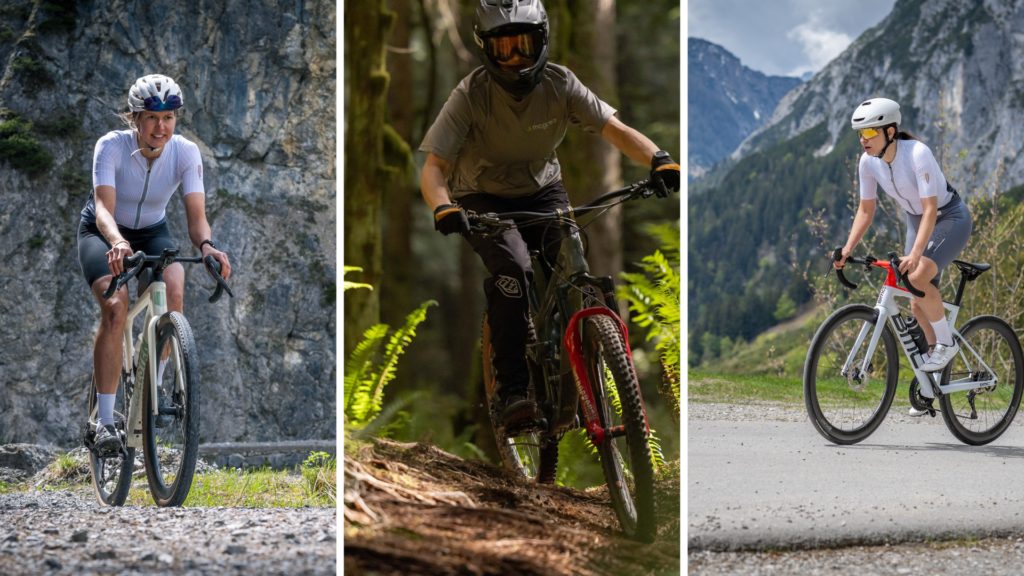
Mountain bike (trail, enduro, downhill)
The problem: fear of crashing at speed, or not getting a foot down quickly enough on a steep, technical section.
What helps: a wide platform with grip pins plus magnets in the middle. Your feet stay planted over roots and rocks, but you are not locked to the bike if it slides away.
- Magped GRAVITY – for downhill, bike parks and enduro, with a very large platform and strong pins.
- Magped ENDURO2 – CNC-machined aluminium, magnets on both sides, a good all-rounder for all-mountain riding.
- Magped SPORT2 – slimmer and lighter, good for cross-country, beginners on trails and lighter bikes.
Gravel and bikepacking
The problem: vibration on rough roads, plus sections where you have to push and walk – and café stops along the way.
What helps: a 2-bolt plate that sits recessed in a walkable rubber sole. Your feet stay connected on the gravel, and the natural rotation protects your knees on long days.
- Magped GRAVEL – light, with a titanium axle, for gravel racing and fast endurance rides.
- Magped SPORT2 – a good entry option with a larger contact area for comfort on long tours.
- Magped ULTRA2 – magnesium body and titanium axle: strong, light and well finished.
Road and commuting
The problem: stopping at lights and busy junctions with slippery plastic cleats – or feet sliding off wet flat pedals in town.
What helps: a secure connection that releases instantly at a red light, without looking down or twisting the ankle, and shoes you can walk in.
- Magped ROAD2 – slim and aerodynamic, for road shoes with the 3-bolt pattern.
- Magped SPORT2 or Magped ULTRA2 – for commuting and city riding with casual 2-bolt SPD shoes.
Frequently asked questions
Are magnetic pedals strong enough for steep climbs?
Yes. Good magnetic pedals hold between 100 N (about 10 kg) and 200 N (about 20 kg) per pedal. That is enough to pull up on climbs, while a strong emergency movement still releases the foot.
Do magnetic pedals work with normal cycling shoes?
Yes. Systems like Magped work with standard 2-bolt (SPD, MTB, gravel) and 3-bolt (Look, SPD-SL, road) shoes. A thin steel plate replaces the usual cleat. Magped lists suitable shoes in its shoe compatibility guide.
Do mud and dirt stop them from working?
Much less than with clipless pedals. Clipless mechanisms have springs and small gaps that clog with mud, ice and stones. Magnetic pedals use flat contact surfaces – a quick wipe of the sole is usually enough, and they also work in the wet.
Our verdict
You no longer have to choose between slipping off flat pedals and the stress of clipless. Magnetic pedals combine efficient pedaling, freedom for the knees and an easy release. Racers who want the most rigid connection will still prefer clipless, and riders who just want to hop on and off in any shoe will stay happy on flats – but for everyone in between, magnetic pedals are well worth a try. Check our reviews of the models above for test scores, specs, pros and cons.